Originally published on Substack
Last week, I traveled to Medora, ND, for ACC’s annual summit. We brought 50 of our top members from across the country to the Badlands to spend a few days together at the newly opened Theodore Roosevelt Presidential Library.
I knew the broad outlines of Theodore Roosevelt’s story before I arrived – how he had ranched in the Dakota Territory as a young man, that his time there had shaped his views on conservation, and that he would later credit those years with preparing him for the presidency. What I hadn’t appreciated was just how important this place had been during one of the most difficult periods of his life. And I certainly hadn’t expected it to affect me on a personal level as much as it did.
On my final morning in Medora, I drove into the Theodore Roosevelt National Park for some post-event solitude and found myself getting suddenly emotional. Winding through the park’s roads, the expansive Badlands revealed itself before me in every direction. Bison wandered through the grasslands. Prairie dogs popped in and out of their burrows. Wildflowers bloomed on the side of the road. It was one of those rare landscapes that felt both enormous and intimate at once.
My destination was the Badlands Overlook, and when I finally arrived and looked out, the stillness and grandeur hit me in a profound way.
Truthfully, it has been a difficult year for me. Nothing catastrophic, and certainly nothing that deserves comparison with the tragedy that brought Roosevelt back to this place nearly a century and a half ago. It has simply been a stressful year, with compounding difficulties, and competing responsibilities. All of us have had moments like this – moments in life that empty the oxygen out of our bodies and our souls.
I took a steep path from the parking lot down to a private landing. And as I sat there above the Badlands, the tension in my life temporarily disappeared. All I could hear was the sound of wind whistling over the rocks and prairie grass. I was breathing clean air. And for the first time in a while, I felt calm and centered.
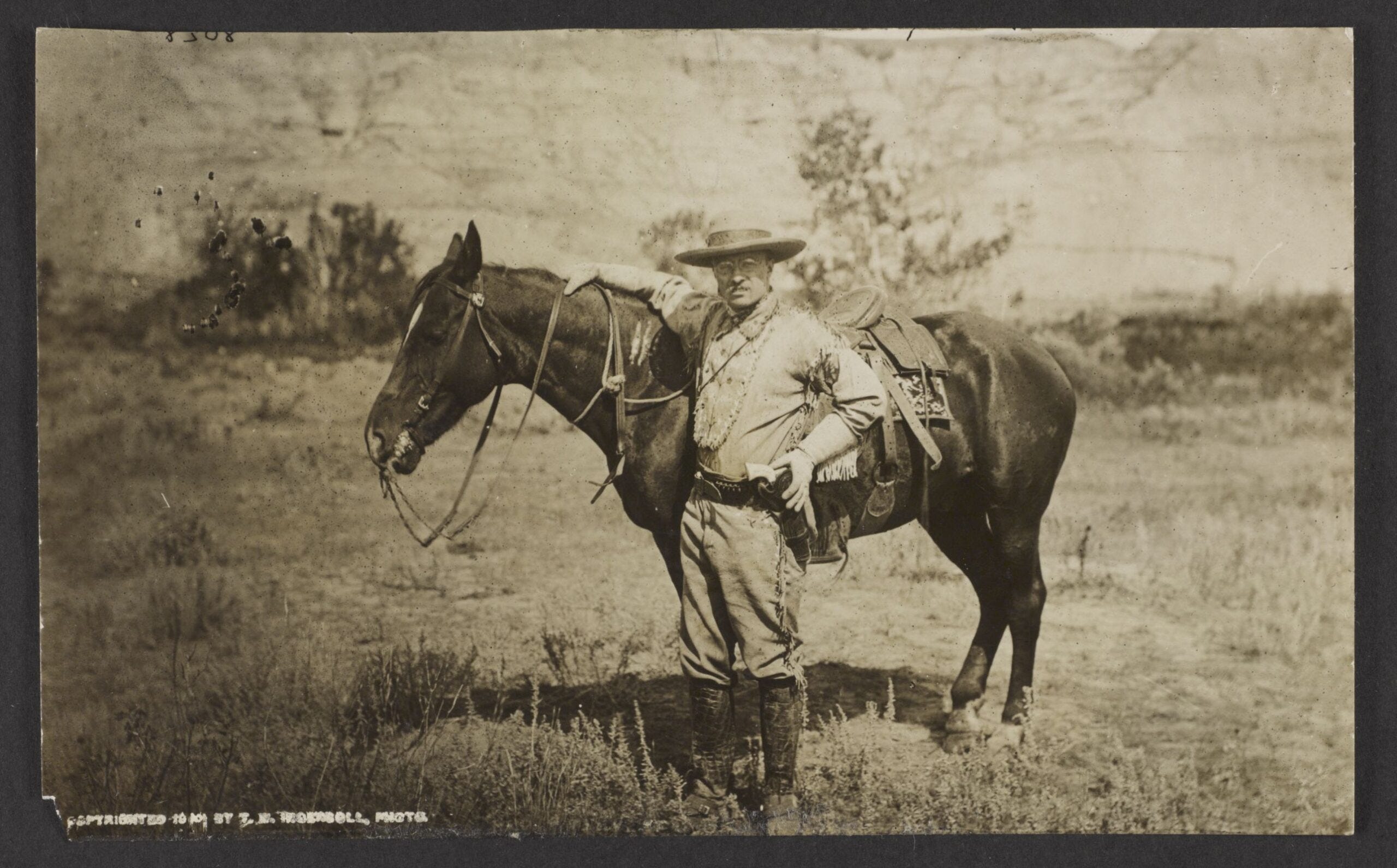
I then found myself picturing the young Theodore Roosevelt and what he must have been searching for when he returned to this place in the summer of 1884. He had first arrived the previous September when he was a 24 year old member of the New York State Assembly, a wealthy young New Yorker with considerable ambition and an almost obsessive appetite for adventure. He had spent much of his childhood battling severe asthma and other health problems, experiences that helped produce his lifelong determination to build his body through physical exertion.
His original reason for coming west was fairly straightforward: he wanted to hunt a bison before they disappeared. After arriving near the newly established town of Medora – as far west as the railroad came at that time – Roosevelt hired a guide and headed into the Badlands. The hunt lasted about two weeks, but by the time it was over, he had become captivated by the area. Before returning east, he invested $14,000 in a cattle operation at the Maltese Cross Ranch, about seven miles south of Medora.
At that point, Dakota was an adventure. Five months later, it would become something entirely different.
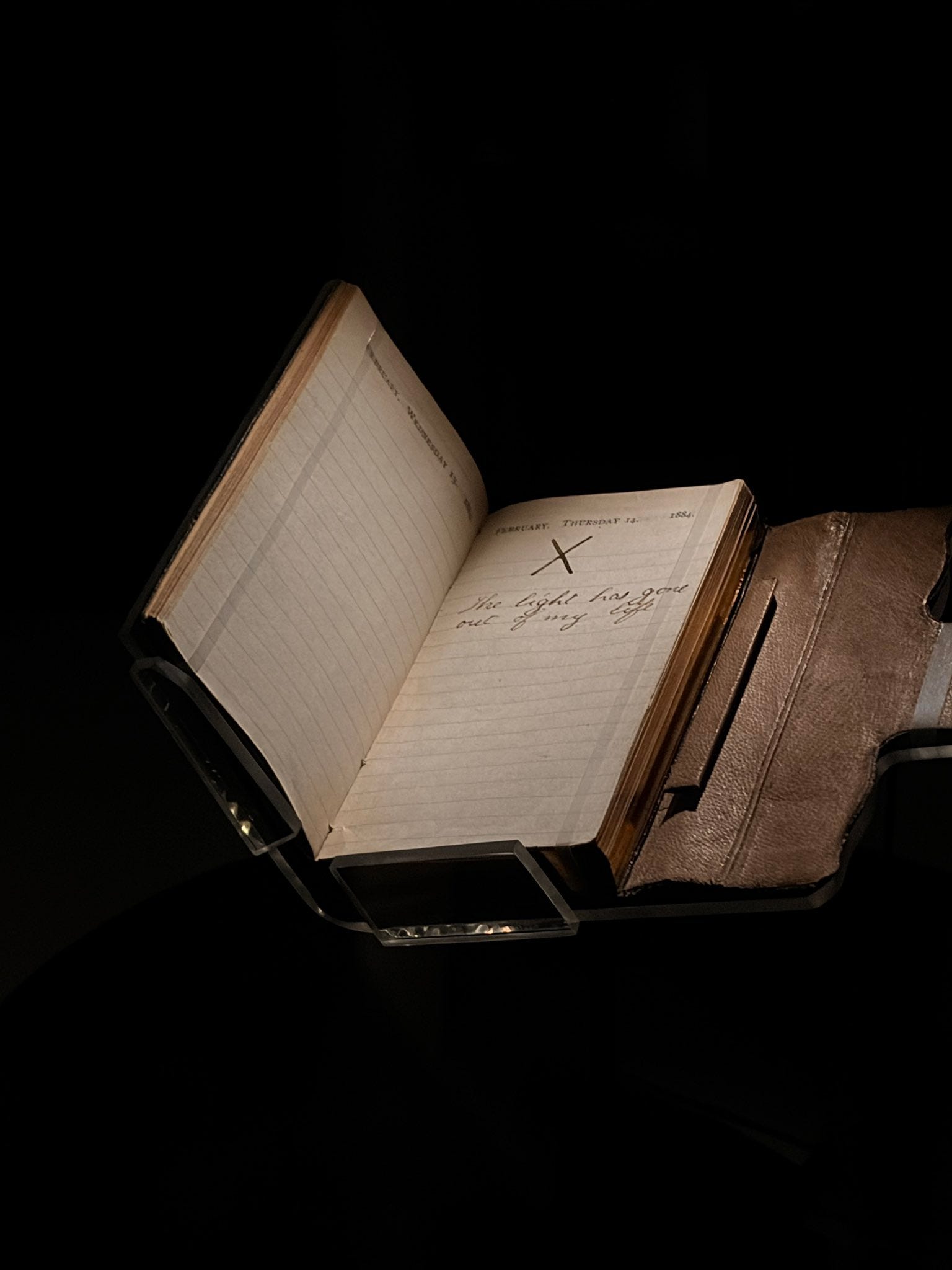
On February 12, 1884, Roosevelt’s wife, Alice, gave birth to their daughter. Two days later, on Valentine’s Day, Roosevelt’s mother, Mittie, died of typhoid fever. Hours later, in the same house, his 22-year-old wife died from kidney disease.
In his diary that day, which was on display at his presidential library, Roosevelt drew a large X across the page and wrote beneath it, “The light has gone out of my life.” His wife’s nickname was Sunshine.
Four months later, still reeling from the devastating loss, Roosevelt returned to the Badlands, this time seeking distance from his pain and a reason to stay alive.
The Maltese Cross Ranch apparently wasn’t far enough away. He established the Elkhorn Ranch roughly 35 miles north of Medora along the Little Missouri River, where his nearest neighbors were miles away. He rode horses, hunted, participated in cattle roundups, read and wrote, chased down thieves, and endured the extreme weather of the plains. The privileged young politician from New York threw himself into a life defined by physical exertion and exposure to a beautiful but unforgiving landscape.
The first time Roosevelt came to the Badlands, he was looking for adventure. This second time, he was looking for himself.
Fifteen years later, Roosevelt would give a speech in Chicago that gave the philosophy he had come to embody a name. He called it “The Strenuous Life.”
“I wish to preach, not the doctrine of ignoble ease,” Roosevelt told his audience, “but the doctrine of the strenuous life, the life of toil and effort, of labor and strife.”
It is easy to reduce Roosevelt’s idea to physical toughness. Certainly, he believed deeply in that. After all, this was a man who responded to childhood illness by deliberately building his body, and remained active his entire life. But the strenuous life was about something larger than physical exertion. It was a rejection of a life optimized around comfort.
Roosevelt believed a meaningful life required effort, responsibility, and a willingness to enter arenas in which failure was possible. The challenges he sought were sometimes physical and sometimes political. Others weren’t challenges he sought at all, but rather those imposed upon him by the circumstances of life.
His years in the Badlands contained plenty of each. Even his ranching venture ultimately failed. The catastrophic winter of 1886-87 killed much of his herd and helped bring his career as a cattleman to an end. But something important had happened to Roosevelt in North Dakota. A sickly boy from New York had proven to himself that he could survive harsh conditions. An East Coast aristocrat had earned the respect of rugged cowboys who initially saw him as a wannabe. An ambitious politician had developed a deeper understanding of a part of America far removed from New York society. A hunting enthusiast had begun to see more clearly what could be lost if America’s wildlife and wild places were not protected. Most importantly, a grieving young man found renewed purpose and returned to public life.
He would later reflect on his experiences, saying, “I never would have been President if it had not been for my experiences in North Dakota.”
It is easy to romanticize Roosevelt’s world from the comfort of ours, but we shouldn’t. Life in 1884 was harder than life today in countless ways, and the tremendous improvements in health, technology, transportation, communication, and material prosperity that separate our lives from his are worth celebrating. It’s not that life became easier, but rather that ease became easier to choose.
Roosevelt’s retreat into the Badlands cost him something – It required a 35-mile ride, months of physical labor, and a willingness to sit alone with his grief instead of numbing it. But as a reward, he returned a new man, ready to reenter the arena. Today, we’ve built a version of retreat that costs nothing and asks for nothing in return. We can withdraw from other people without ever leaving our couch, and unlike Roosevelt’s, our withdrawal has no real reason to return. We don’t have to engage seriously with someone who disagrees with us when an algorithm can surround us with people who already share our worldviews. Even silence has become optional, because the moment we grow uncomfortable with our own thoughts, an endless supply of content is waiting in our pockets to distract us.
We have eliminated many of the hardships Roosevelt’s generation endured. We haven’t, however, eliminated the need to develop the qualities that hardship once demanded.
Every generation gets its own version of the strenuous life. And those who shy away from it will pay a price.
In an age of political division, ours requires building relationships with people who disagree with us instead of retreating into ideological tribes. In an age of declining civic participation, it means leading instead of criticizing our institutions from the sidelines. In an age dominated by technology and social media, it means reclaiming ownership of our attention rather than surrendering hours of our lives to an algorithm. In an age of loneliness, the strenuous life may be the decidedly unglamorous work of building real community. In an age of cynicism, it means believing that society can still be improved and accepting some responsibility for making them so.
When it comes to leadership, our challenges may be more familiar to Roosevelt than we realize. Leadership still requires us to be decisive, accept criticism, navigate conflict, and take responsibility when things go wrong. It requires us to endure setbacks and continue showing up when the work stops being exciting. It requires the humility to recognize when we are wrong and the courage to stand alone when we believe we are right.
There is no technological innovation that can remove those burdens from leadership, nor should there be. The burden is part of what prepares us to carry greater ones.
Sitting at that overlook, the longer I looked across the Badlands, the smaller certain things began to feel. The problems waiting for me hadn’t actually disappeared, the difficult moments of the past year hadn’t suddenly been resolved, and I didn’t walk away with some grand revelation about what I should do next. I simply had enough distance from the noise to put some things back into perspective.
For the first time, I understood in some small way why a grieving 25 year old Roosevelt kept riding farther away from Medora until he found a place remote enough to be alone. He needed the wilderness. And even today, I think we all do. Not because nature magically solves our problems, or because spending a weekend in a national park somehow transforms us into Theodore Roosevelt. Nature offers something much simpler and perhaps more useful: a place that interrupts daily life enough to invigorate and heal our souls.
Healing in nature is something I think more young people desperately need. It’s the deeper reason behind the call to “touch grass.”
As our summit attendees learned about Roosevelt’s legacy, my sincere hope is they also learned the heavy and difficult lessons he had to learn before he ever secured a legacy.
I also hope, as they learned about his retreat into the Badlands, they also understand the weight of his return to public life afterward. He didn’t stay our west – he came back, returned to politics, and continued entering increasingly difficult arenas. He fought corruption as a civil service commissioner and New York City police commissioner, served as Assistant Secretary of the Navy, led the Rough Riders during the Spanish-American War, and became governor of New York. He became vice president and, eventually, the 26th President of the United States.
In that spirit, my message for emerging leaders is simple: Embrace the strenuous life. Spend time with, and even challenge, your own thoughts. Find your purpose and, once you do, be radically unapologetic about pursuing it.
The wilderness didn’t teach Roosevelt to escape the arena; it prepared and encouraged him to reenter it.
We may not all be called to become president, but all of us will eventually be called to lead something. It might be a family, a business, a neighborhood, a nonprofit, a classroom, a church, or a movement. Sometimes the first and most difficult thing we are called to lead is simply ourselves.
When that moment comes, our instinct may be to take the easy path. Roosevelt’s story challenges us to choose the opposite.
Don’t spend your life trying to avoid difficult conditions. Ride directly into them.