
Originally published on Substack
Over the last few months, we’ve implemented something new across our leadership team: an organizational scorecard. It’s a simple idea, inspired by the EOS scorecard system. But it’s already changing how we operate.
Each week, our department VPs and I review and update a simple matrix of the organization’s most important metrics – the drivers that tell us whether we’re on track or not. We look at things like membership growth, events, fundraising, employee happiness, and a few other criteria. Nothing too complicated. Just a single, living scorecard that we update every week and apply an “on track” or “off track” label.
The purpose of a scorecard isn’t to add more reporting. It’s to keep the most vital indicators front and center.
An early win
A few weeks after rolling it out, one of my VPs noticed that their team was falling behind on one of their core metrics. This was a number they would typically check at the end of the month. But because we determined it was important enough for weekly tracking, they caught it early. That allowed them to flag it for their team and figure out a game plan to correct it. Just like that: an off-track metric is now getting back on track.
In the past, that same metric probably wouldn’t have been reviewed until the end of the month, at which point it may have been too late to change the outcome.
That early win validates the scorecard concept. When you track your most vital numbers weekly, you can effectively predict the future. You start to see problems before they happen.
Design an organizational scorecard that works for you
Admittedly, creating this ‘simple’ scorecard wasn’t so simple at first. Some metrics were obvious to include, whereas in some areas, we struggled to determine which metrics to track.
Start by asking yourself what you want to achieve. What are the things your organization is ultimately judged by? Once you have end goals in mind, think about which regular actions most directly help you achieve them. Those are the metrics that belong on your scorecard.
By the way, measurable doesn’t mean it has to be a number – it can be a yes or no. For example, you might track whether a newsletter was sent or a meeting occurred. Just try to limit over-reliance on this, as it’s not as useful as a number.
For fundraising, maybe it’s the number of grant applications submitted each week or the number of donor touchpoints made. For membership, it might be new signups or recruitment events hosted. For employee happiness, it might be something as simple as the number of one-on-one check-ins completed.
If you’re building one for an entire organization, entrust your area leaders with developing their own metrics. Then, put the name of the “owner” of each metric – they’re going to be the person responsible for updating it every week.
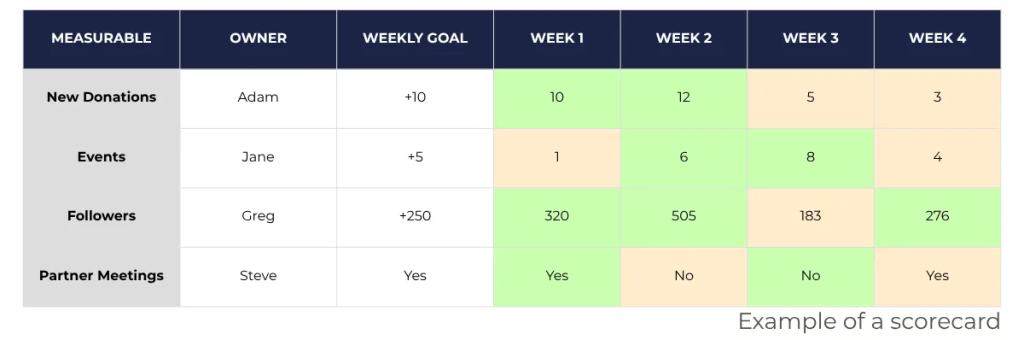
The idea is to identify your leading indicators – the numbers that move long before the outcome does. Those are the ones that help you see into the future.
Build consistency and make scorecard reviews useful
Once your scorecard is set, you have to make a habit of updating and reviewing it.
Each week, the owner of each metric updates the scorecard and notes which are on or off track. If something is seriously off track, don’t wait – schedule a meeting to discuss and solve it.
Find a time to review the scorecard with your team regularly. We go over ours monthly during a standing meeting between me and our VPs. The review itself should be quick – ideally five minutes at most. All you’re doing is confirming what’s on track, flagging what’s not, and deciding where follow-up is needed. Then, later in that same meeting (or in a subsequent meeting if there’s not enough time), address the off-track metrics and identify actionable ways to correct course.
The power of a scorecard comes from using it consistently and acting when it signals a potential issue.
Predict the future. Achieve more goals.
Like with any new system, there can be some discomfort. But with time, this simple weekly check-in on your goals can become invaluable. When done correctly, you stop relying on intuition alone and start making decisions rooted in consistent and visible data. You’ll stop getting to the end of a quarter or year and wondering why a goal slipped.
When you can see your organization’s future a week at a time, you can shape it intentionally.